Why a Metadata Platform? When Distributed Knowledge Stops Scaling
Understanding Metadata Systems — Part 2
Previous: Why Metadata? When Data Alone Is Not Enough
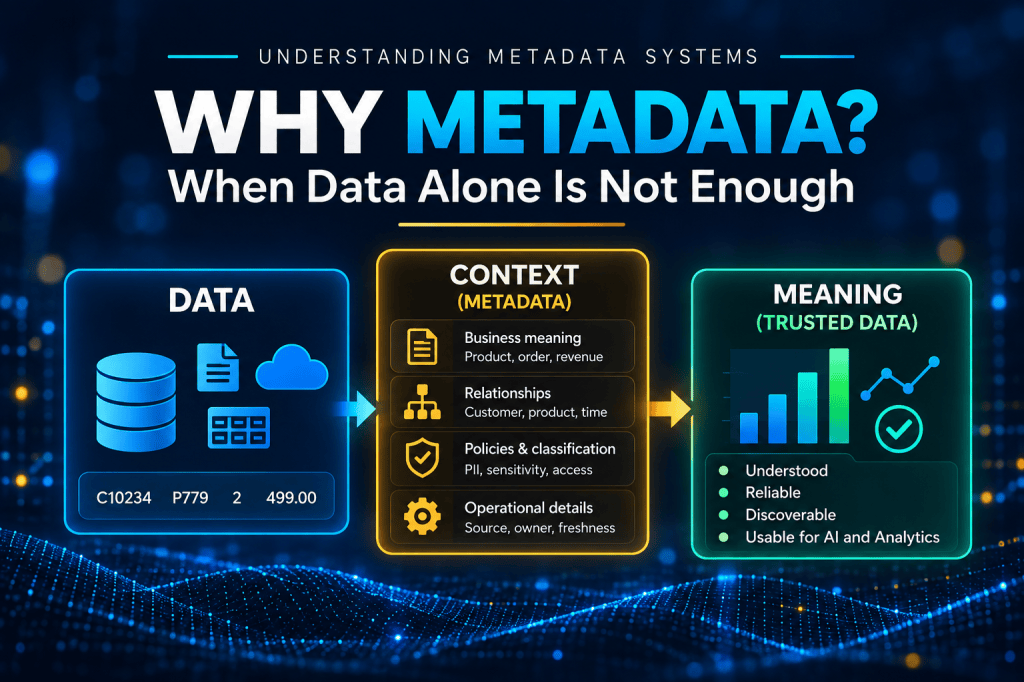
In the previous article, we addressed a foundational premise: if data already resides in operational databases, warehouses, object stores, and event streams, why do we need metadata?
I would like to emphasize on the point that data alone lacks sufficient context for humans and machines to interpret and consume it reliably. Furthermore, that context rarely originates from a single place:
- Technical schemas live in databases and data warehouses.
- Business definitions live in domain teams and wikis.
- Classifications live in security and governance registries.
- Quality signals live in data observability platforms.
- Operational state lives in schedulers and pipeline orchestrators.
This raises an obvious architectural question:
If valid, authoritative metadata already exists across these systems and teams, why introduce another platform to centralize it?
Before justifying a new piece of infrastructure, we must first establish when distributed metadata works well without one.
When Distributed Metadata Works
Consider a single bounded context: a small engineering team responsible for an order service backed by PostgreSQL.
The schema contains a customer_orders table. The developers/engineers maintain the application, understand the data model, keep lightweight documentation close to the codebase, and know the domain boundaries intuitively.
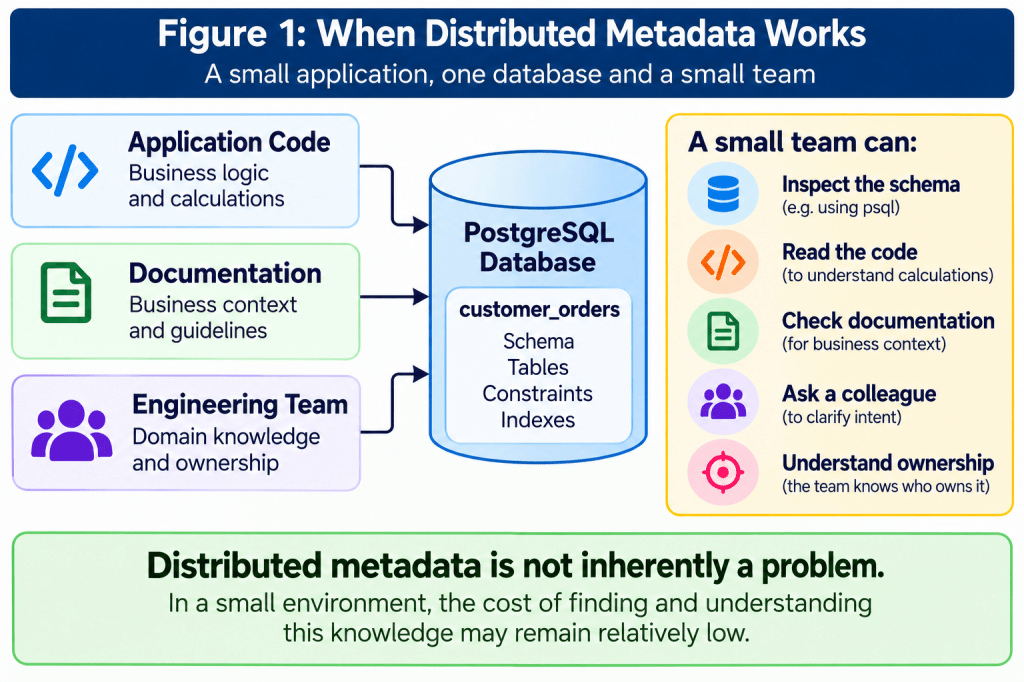
If an analyst or engineer needs to work with customer_orders:
- Schema details are visible via
psqlor database migration files. - Calculation logic (e.g., net price vs. gross tax) is explicit in application code.
- Business definitions are captured in team documentation or clarified in a brief conversation.
- Ownership is obvious—the team running the service owns the table.
The metadata is physically distributed: split across PostgreSQL system catalogs, Git repositories, Markdown files, and human memory.
Yet, this introduces zero operational friction. The critical metric is not whether metadata is physically co-located; it is the cognitive and procedural cost for a consumer to find, assemble, and trust that knowledge.
In a small environment, that cost approaches zero. Introducing an external catalog or metadata engine here would introduce operational overhead, synchronization lag, and maintenance debt without solving a tangible problem.
Distributed metadata is not inherently broken.
What Changes as Scale Multiplies?
Friction emerges when system boundaries expand faster than human networks.
First, one application becomes ten or even more. Teams adopt specialized operational datastores, replicate transactional subsets into an analytical warehouse, schedule asynchronous dbt models, and build operational dashboards. Finding context now requires navigating several Slack channels and repository wikis.
Now, scale to enterprise dimensions:
- Hundreds of microservices and streaming topics.
- Tens of thousands of database tables, views, and object-store buckets across GCP, AWS, Azure and on-premises environments.
- Heterogeneous data models spanning operational databases, lakehouses, real-time message brokers, BI workspaces, and feature stores for machine learning and agentic workflows.
- Cross-functional domain boundaries where producers and consumers operate in different business units and geographic regions.
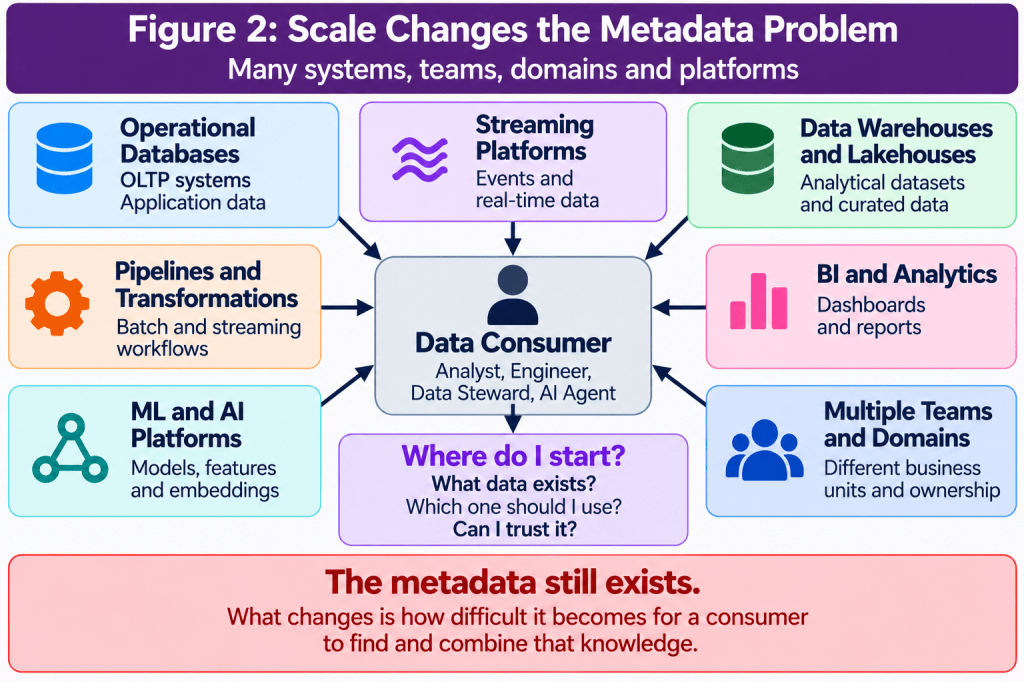
At this scale, the metadata still exists:
- The transactional database still understands its internal types and constraints.
- The domain team still understands their business definitions.
- The orchestrator still logs task execution timestamps and failures.
- The data-quality harness still checks for null invariants and volume anomalies.
The failure mode is that the consumer no longer has a deterministic entry point.
1. The Discovery Problem: Finding Assets Before Understanding Them
Before asking what an asset means, an engineer, analyst, or AI agent must resolve a foundational question:
Does the dataset I need exist anywhere in the company?
Searching for order data at enterprise scale rarely yields a single canonical table. Instead, it surfaces fragmentation:
customer_orders(Raw replication, updated continuously)customer_orders_v2(Staged operational snapshot)orders_curated(Finance-reconciled monthly dataset)sales_orders(Regional CRM extraction)customer_order_history(Legacy warehouse migration artifact)orders_reporting(Denormalized BI layer)
If the consumer knows the precise database, schema, and object identifier, they can run an inspection query. But when requirements are conceptual—“I need verified customer churn metrics for EMEA”—direct inspection fails.
Capability 1: A unified discovery mechanism that indexes data assets across heterogeneous runtime boundaries.
2. The Context Problem: Discovery Without Verification Is Dangerous
Finding six prospective datasets does not unblock work. It creates an evaluation bottleneck:
- Which dataset represents the current canonical record?
- Does
orders_curatedexclude test accounts and canceled orders? - Who has operational accountability when an upstream schema migration fails?
- Does this table expose unmasked PII or restricted financial information?
- Is the daily batch SLA met reliably, or does the pipeline drift?
- What downstream pipelines, executive reports, or ML features break if we alter this contract?
Knowing an asset exists confirms presence. Determining fit-for-purpose requires multi-dimensional context.
3. The Integration Problem: Distributed Authoritative Systems
To evaluate a single dataset like orders_curated, a consumer must query distinct platforms, each authoritative for only one aspect of system state:
| Knowledge Dimension | Authoritative Source System |
| Physical Schema & Column Types | Database / Warehouse Engine (INFORMATION_SCHEMA) |
| Business Intent & Semantics | Business Domain Team / Data Product Spec |
| Data Classification & Privacy Policy | Security & Governance Registry (e.g., Apache Ranger, Cloud IAM) |
| Data Health & Assertions | Observability & Testing Frameworks (e.g., Great Expectations) |
| Freshness & Execution State | Orchestration Engine (e.g., Airflow, Temporal) |
| Upstream Lineage & Downstream Impact | Transformation & Query Logs (e.g., dbt manifests, OpenLineage) |
| Asset Ownership & Escalation Path | Identity & Access Directory / Service Catalog |
Expecting consumers or automated pipelines to query seven control planes for every query is unworkable. It requires bespoke access tokens, disparate API clients, and continuous manual reconciliation.
Capability 2: An integration and translation layer that extracts, correlates, and aggregates metadata across disparate system boundaries.
4. The Structural Problem: Heterogeneous Ontologies and System Boundaries
Different technologies categorize metadata according to their local abstractions:
- Relational engines understand databases, tables, columns, and foreign keys.
- Streaming systems understand clusters, topics, partitions, offsets, and Avro/Protobuf schemas.
- Modern analytics systems understand datasets, semantic models, metrics, and dimensions.
- Orchestrators understand DAGs, tasks, retries, and run dependencies.
- Machine learning platforms understand feature sets, training runs, evaluation metrics, and model artifacts.
Furthermore, data flow implies systemic connectivity. An order originates as an application event, traverses an event broker, undergoes micro-batch streaming transformations, lands in an Iceberg lakehouse, aggregates into a semantic layer, and feeds both an executive KPI dashboard and a vector search pipeline.
Understanding the behavior of that downstream metric requires modeling relationships across technological and organisational boundaries.
Capability 3: An extensible metadata graph capable of mapping both entity details and cross-system lineage relationships.
Defining the Metadata Platform
A metadata platform is not merely a database about data.
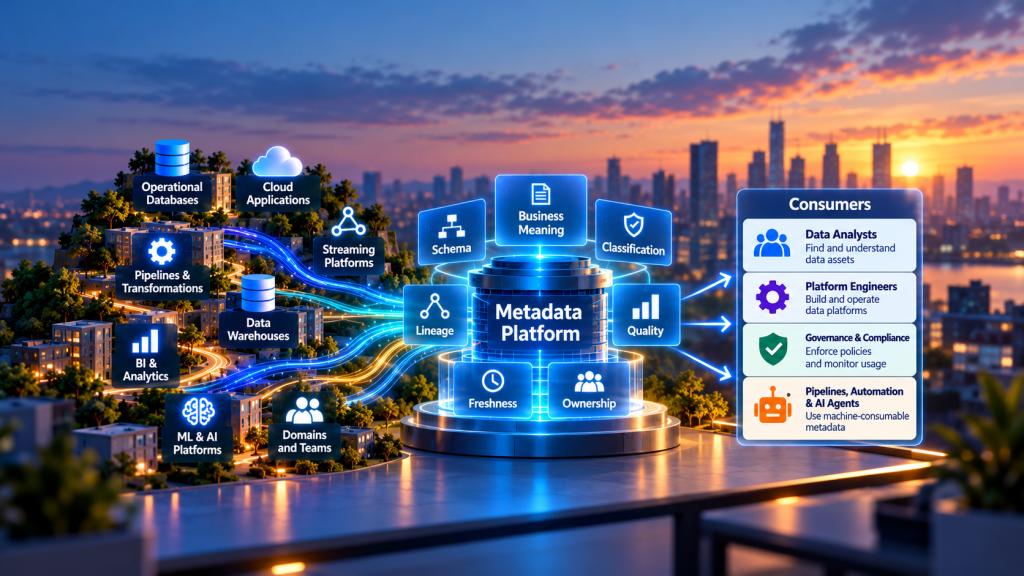
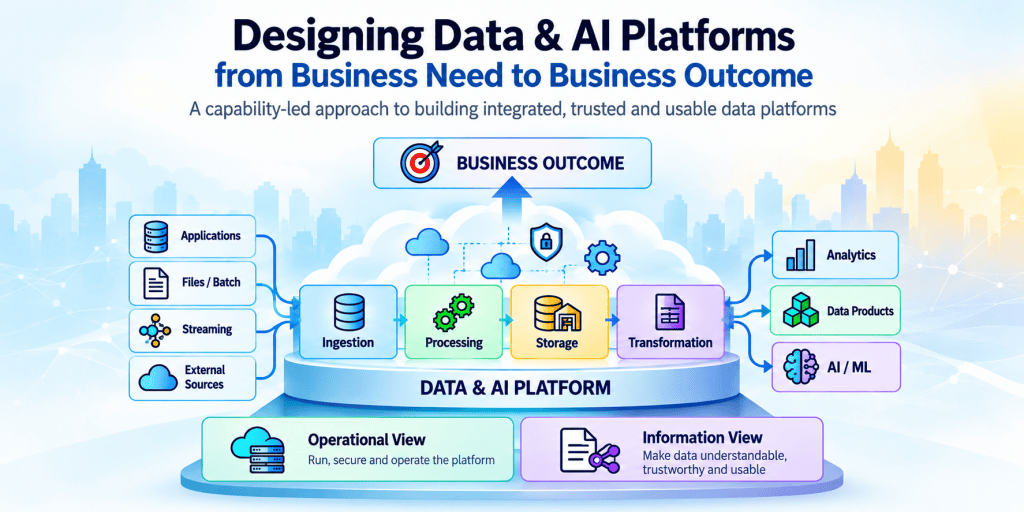
A metadata platform is a shared technical capability that continuously ingests, unifies, correlates, and serves metadata from distributed systems to make enterprise data discoverable, understandable, and actionable for humans, automated pipelines, and autonomous agents.
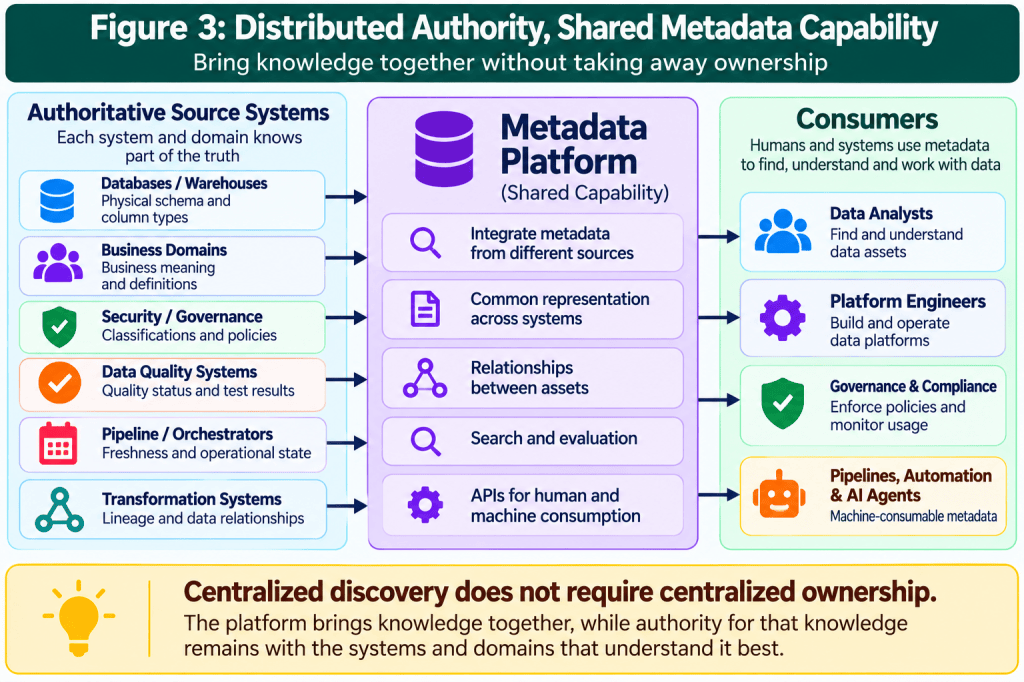
Crucially, ingesting metadata into a shared platform does not make the platform authoritative for that metadata.
- If BigQuery specifies that
amountisNUMERIC(12, 2), BigQuery remains the authority for the physical data type. - If the Payments domain defines gross platform revenue, that domain remains the authority on calculation logic. Storing that definition in the platform does not transfer business responsibility to the metadata platform team.
- If security designates an identifier as sensitive PII, security policy dictates that rule. The platform indexes and exposes the classification for governance enforcement.
This establishes an architectural invariant:
Centralized discovery does not require centralized ownership.
The metadata platform functions as an aggregate control plane. It integrates and correlates distributed state; it does not claim unilateral semantic authority over enterprise domain data.
Untangling the Terminology: Repository, Catalog, Platform, or Management?
These terms are frequently used interchangeably in vendor materials, leading to architectural confusion:
1. Metadata Repository
The underlying persistence and indexing store. It provides a datastore (document, relational, or graph) optimized to persist metadata entities, schemas, and edges. A repository is an infrastructural component, not a complete solution.
2. Data Catalog
The consumer-facing presentation and exploration layer. Similar to a library catalog, it indexes what exists, displays structural summaries, and exposes search and evaluation interfaces. A catalog is typically a user-facing product application built on top of metadata storage.
3. Metadata Platform
The broader operational and integration architecture. In addition to a repository and catalog UI, a metadata platform provides:
- Push- and pull-based ingestion frameworks.
- Bi-directional APIs and event-driven egress (e.g., emitting change notifications when schemas alter).
- Automated end-to-end lineage extraction.
- Programmatic interfaces for both human developers and downstream automation (such as CI/CD schema checks, access managers, and agentic workflows).
4. Metadata Management
The broader sociotechnical discipline. It encompasses the organizational contracts, data product standards, governance frameworks, team operating models, and review workflows that keep metadata accurate over time. Technology can support metadata management, but tools alone cannot enforce operational discipline.
Architectural Realities: The Next Bottlenecks
A metadata platform addresses discovery, cross-system correlation, and multi-source context assembly.
However, resolving the technical aggregation challenge introduces governance and operating model challenges:
- If metadata originates across multiple domain teams, who is accountable when descriptions, schemas, or freshness SLAs are wrong?
- When an upstream operational database and a downstream dbt model disagree on naming or classification, which control plane wins?
- Can a central platform team safely modify domain tags, or does that break domain boundaries?
- How do we control access to metadata itself when schemas or column descriptions expose sensitive business logic?
- Does a centralized platform inevitably force organizations into a bureaucratic, centralized governance committee?
These are operational and organizational design questions rather than storage engineering problems.
| Knowledge | Possible authoritative source |
|---|---|
| Physical schema | Database / warehouse |
| Business meaning | Business domain |
| Classification | Security / governance |
| Quality status | Data-quality system |
| Freshness | Pipeline / orchestrator |
| Ownership | Organizational process |
| Lineage | Transformation / processing systems |
Different technologies also describe their assets differently.
A database understands tables and columns. A streaming platform understands topics and schemas. An orchestration system understands workflows and tasks. A BI platform understands dashboards and reports. An ML platform may understand features and models.
These assets are also related.
A source application may produce an event, which is transformed by a pipeline, stored in a warehouse, consumed by a dashboard and later used by an ML or AI application.
Therefore, understanding an asset may require knowledge that crosses several system boundaries.
Requiring every consumer to visit all these systems individually does not scale well.
What Capabilities Have We Actually Derived?
Rather than starting with a metadata product and examining its feature list, let us look at what the problem itself has told us we need.
We need discovery so consumers can find what assets exist.
We need integration because useful metadata comes from different systems and teams.
We need a common representation because different technologies describe their assets differently.
We need relationships so that assets can be connected across system boundaries.
We need search and evaluation so consumers can determine which assets are appropriate for their requirements.
And we need metadata to be machine-consumable, because metadata consumers are not only humans. Pipelines, governance systems, automation and increasingly AI applications also need context.
Notice that these capabilities did not come from a product feature list.
They emerged from the problems we encountered as the environment grew.
So What Is a Metadata Platform?
We can now arrive at a working definition:
A metadata platform is a shared technical capability that integrates, represents, relates and makes metadata from distributed sources discoverable and consumable by humans and systems.
Instead of requiring every consumer to understand every metadata source independently, the platform provides a shared way of discovering and consuming that knowledge.
But this introduces an important distinction.
Suppose a warehouse tells us that price is DECIMAL(10,2).
The metadata platform may collect and expose that information, but the warehouse remains authoritative for the physical schema.
If the Finance domain defines what price means, storing that definition in the metadata platform does not make the platform team authoritative for its business meaning.
Similarly, if a security or governance process classifies customer_id as sensitive, the metadata platform can expose that classification without becoming the authority that decides it.
This leads to an important architectural principle:
Centralized discovery does not require centralized ownership.
A shared metadata platform can bring distributed knowledge together while authority for that knowledge remains with the systems and domains that understand it best.
Repository, Catalog, Platform or Metadata Management?
These terms are often used interchangeably, but they describe different concepts.
| Concept | Primary purpose |
|---|---|
| Metadata Repository | Stores metadata |
| Data Catalog | Helps consumers discover and understand data assets |
| Metadata Platform | Integrates, represents, relates and serves metadata to different consumers |
| Metadata Management | The wider discipline involving people, processes, governance and technology |
The boundaries are not always rigid. A modern product may provide several of these capabilities.
The important point is that metadata management is not simply a technology product. A platform can provide technical capabilities, but people and organizational processes still determine responsibility, authority and governance.
Solving One Problem Creates Another
We started with a small environment where distributed metadata could work perfectly well.
As the environment grew, finding and combining that knowledge became increasingly difficult.
This led us to derive the need for discovery, integration, common representation, relationships, evaluation and machine consumption—and eventually to the idea of a shared metadata platform.
But bringing metadata together creates another set of questions.
Who owns the metadata?
Who decides which source is authoritative?
Who is accountable when metadata is incorrect?
Can a central platform team modify business metadata owned by another domain?
What happens when different sources disagree?
Does a shared metadata platform require centralized governance?
These questions cannot be answered by technology alone.
They lead us to the next architectural problem:
If metadata comes from many systems and domains but is made available through a shared platform, who actually owns it—and who decides what is authoritative?
Continue the Series
Previous: Why Metadata? When Data Alone Is Not Enough
Next: Who Owns Metadata? Authority, Accountability and the Operating Model — Coming soon


Leave a Reply