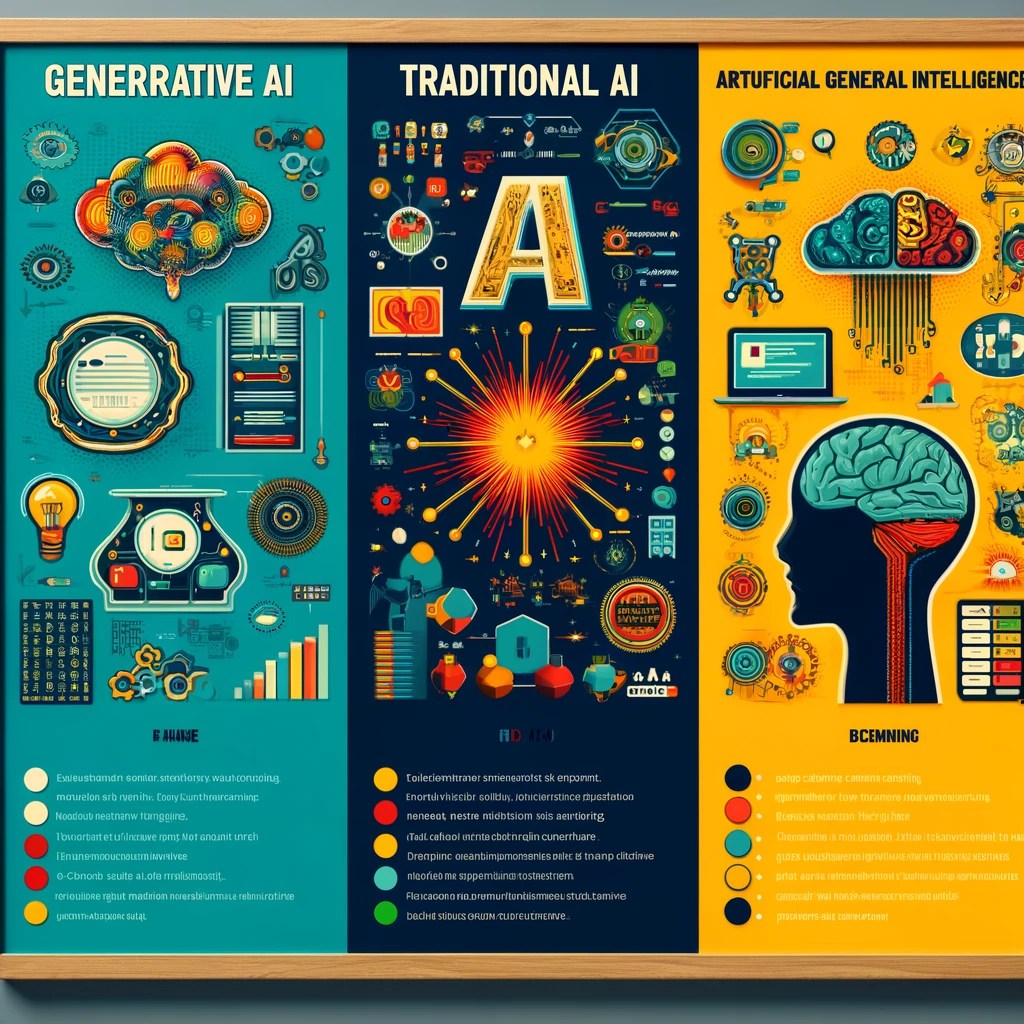
In today’s rapidly evolving IT landscape, Artificial Intelligence (AI) stands out as a pivotal force driving significant transformations across various facets of technology and business operations. The integration of AI into IT strategies is not merely about streamlining processes; it’s reshaping how organizations innovate, operate, and compete.
As an experienced IT Infrastructure professional, I have been investigating the importance of Artificial Intelligence (AI) in the routine responsibilities of IT Infrastructure Engineers, DevOps Engineers, and Site Reliability Engineers (SREs). Through this exploration, I discovered the existence of various AI models, highlighting a common misunderstanding among individuals regarding the distinctions among Traditional AI, Generative AI, and Artificial General Intelligence (AGI). It has become evident that the term AI is often used interchangeably with Generative AI, despite it being merely one variant of AI.
Hence I thought of finding answers to the following questions came to my mind and share it with the wider audience. This could help me to understand the subject in a better way at the same time it might help others in some way as well.
- Exploring AI Variants: “What are the main differences between Traditional AI, Generative AI, and AGI, with examples?”
- AI’s Role in Tech: “Can you describe how Traditional AI, Generative AI, and AGI might transform IT Infrastructure, DevOps, and SRE, including examples of their impact?”
- Implementing AI in Tech Operations: “What are the key steps for integrating Traditional AI, Generative AI, and AGI into IT Infrastructure, DevOps, and SRE?”
- AI and Employment Trends: “How could Traditional AI, Generative AI, and AGI influence employment opportunities broadly?”
- AI’s Impact on IT and Engineering Jobs: “How might Traditional AI, Generative AI, and AGI reshape career paths in IT Infrastructure, DevOps, and SRE?”
- Career Prospects in the Age of AI: “Will IT Infrastructure Engineers, DevOps Engineers, and SREs find new career avenues or face obsolescence due to the advent of Traditional AI, Generative AI, and AGI?”
There are many more questions that arise when we think about adoption and impact of AI in day to day operation in the current IT environment. We will get into those questions later on as we progress with our exploration.
Let’s delve deeper into each of the areas mentioned, offering a more elaborate and detailed exploration suitable for a nuanced understanding, particularly in the context of IT Infrastructure, DevOps, and SRE.
Understanding AI in IT: A Simple Guide
The Three Faces of AI: Traditional, Generative, and AGI
Imagine you’re working with three different kinds of robots to manage an IT network. Each robot has its unique skills based on the type of AI it embodies.
Traditional AI: This is your rule-following robot. It’s excellent at tasks where the instructions are clear and don’t change much, like sorting emails or organizing files according to a set pattern. In the IT world, it’s like those systems that help keep your computer network running smoothly by following predefined rules – think of it as the diligent worker who follows the manual to the letter.
Generative AI: Now, this robot is a bit of an artist. It learns by looking at a lot of examples and then tries to make something new that’s similar. In IT, imagine a tool that can write a new code by learning from all the code it has seen before. It’s like having a creative teammate who can draft up project plans or design templates by learning from past projects.
Artificial General Intelligence (AGI): This is the robot of the future, one that can think and learn like a human. It’s not just about following rules or making things similar to what it has seen; it’s about understanding and innovating. In IT, this would be like having a colleague who could handle any task you could, from fixing complex network issues to planning the future tech strategy, all on their own.
How Do These AI Technologies Change IT Jobs?
The big question for many is, “Will these robots take our jobs?” Well, it’s more like they’ll change how we work, and here’s how:
- Traditional and Generative AI are already taking over repetitive tasks, freeing us humans to tackle more complex challenges. They’re like the new age tools that help architects design buildings or assist chefs in creating new recipes.
- AGI might still be a bit off into the future, but it promises a world where AI can work alongside us, taking on tasks we never imagined could be automated, offering us even more space to innovate and create.
Adapting to the AI Revolution in IT
The key to thriving in this new era isn’t to compete with AI but to learn how to work with it. Here’s what can help:
- Stay Curious: Just like you’d learn about a new tool or software that makes your job easier, learn about AI and how it can benefit your work.
- Be Flexible: Jobs will evolve, and being open to change will make transitions smoother. It’s about leveraging AI to do the heavy lifting so you can focus on the strategic stuff.
- Upskill: Learning about AI, data analysis, and even the basics of coding can make you invaluable in an AI-enhanced workplace. Think of it as learning a new language in a foreign country – it helps you navigate better and opens up new opportunities.
The Future of IT Work
The introduction of AI into IT doesn’t signal the end of human jobs but rather the evolution of them. As we delegate more routine tasks to AI, our roles will elevate to more creative, strategic, and analytical functions. It’s not about machines vs. humans but how machines can augment our abilities and enrich our careers.
In conclusion, as Traditional AI, Generative AI, and the promise of AGI reshape our IT landscapes, our focus should shift from fearing obsolescence to embracing the potential for growth and innovation. The future is about collaboration between human creativity and machine efficiency, leading to unprecedented advancements and opportunities in the field of IT.
Let’s present the information in a structured tabular format that simplifies comparison and enhances understanding.
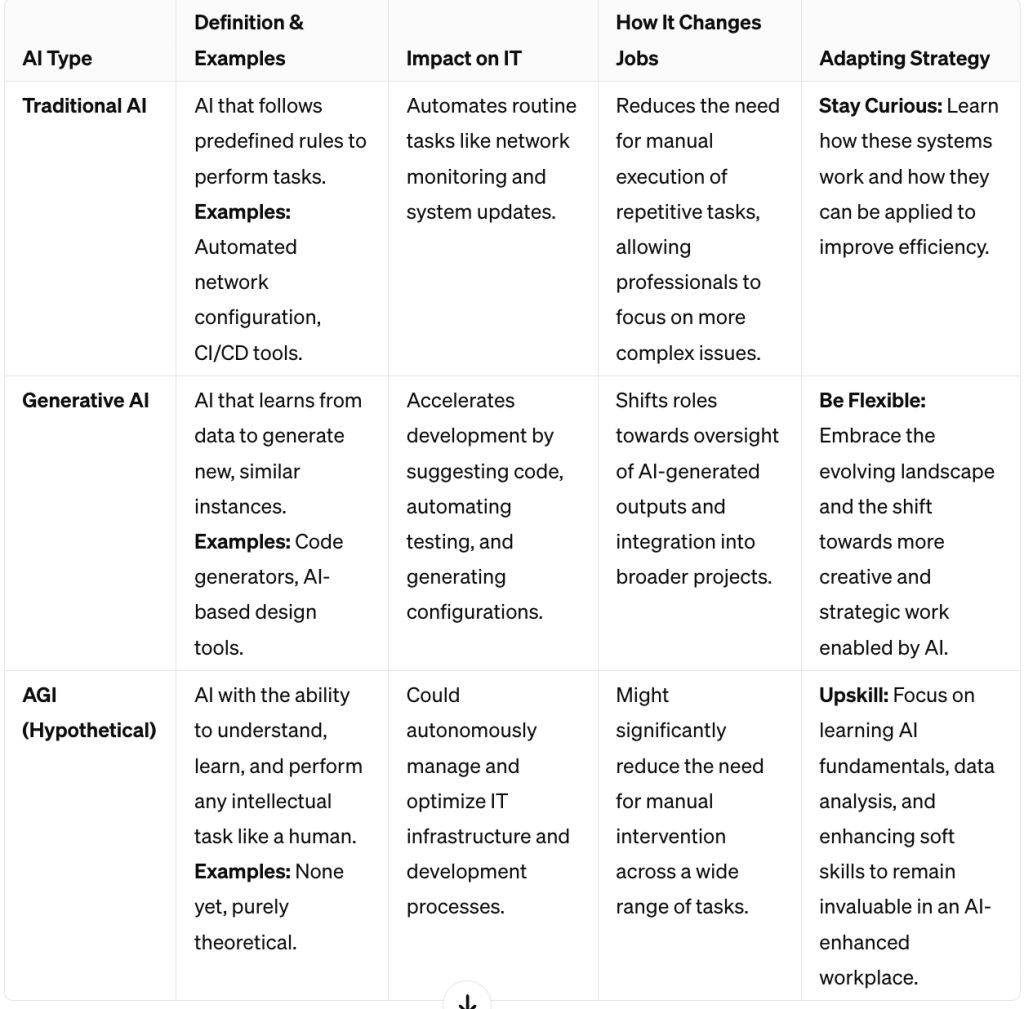
The Future of IT Work in the Age of AI
- Traditional and Generative AI are transforming IT jobs from manual and repetitive tasks to roles that require oversight, creativity, and strategic thinking.
- AGI represents a future where AI could collaborate with humans on equal footing, handling complex tasks and potentially driving innovation in ways we haven’t yet imagined.
- Adaptation Strategies include staying informed about AI advancements, being open to change, and continuously upgrading skills to complement AI capabilities.
Let’s delve into some realistic and relatable examples of how each type of AI is implemented in the IT field, providing a clearer understanding of their applications and impacts:
Traditional AI: Rule-Based Automation
- Automated Ticketing Systems: Traditional AI can power help desk systems where customer queries are automatically categorized and routed to the appropriate department based on keywords or phrases. For instance, if a ticket submission includes the word “password,” it’s automatically directed to the IT security team.
- Network Optimization: Traditional AI algorithms can monitor network traffic patterns and automatically adjust bandwidth allocation to optimize performance. This ensures that critical applications receive the necessary resources, especially during peak usage times.
Generative AI: Creative and Predictive Solutions
- Code Generation: Tools like GitHub Copilot utilize generative AI to suggest code snippets and entire functions based on the context of the existing code and comments. This can significantly speed up the software development process by providing developers with ready-to-use coding solutions.
- Infrastructure as Code (IaC): Generative AI can also assist in generating scripts for automating the deployment of servers, storage, and networking in the cloud. By learning from existing IaC scripts, AI tools can suggest optimizations and new scripts that improve efficiency and reduce errors.
AGI: Theoretical but Transformative
- Fully Autonomous IT Management: Imagine an AGI system that can manage an entire IT infrastructure, from responding to security threats in real-time to optimizing cloud resources for cost and performance without human intervention. It would continuously learn from its actions and from new data, adapting its strategies to ensure the most effective management of IT resources.
- Innovative Problem-Solving: In software development, an AGI could theoretically understand the end-user requirements from a simple description and then design, code, test, and deploy the application entirely on its own, choosing the best frameworks and technologies for the job. It could also foresee potential challenges and solve them before they arise.
Realistic Implications for IT Professionals
- For those in IT support and operations, traditional AI’s automation of routine tasks means a shift towards handling more complex issues that require human judgment and intervention.
- Software developers leveraging generative AI tools like code generators can focus more on the creative and architectural aspects of software development, leaving the mundane coding tasks to AI.
- While AGI remains hypothetical, its potential underscores the importance of IT professionals focusing on skills that AI is unlikely to replicate easily, such as strategic planning, creative problem-solving, and human-centered design.
By understanding and leveraging these AI technologies, IT professionals can not only streamline their current tasks but also carve out new roles and opportunities in an increasingly AI-integrated future.
Lets touch up on few more questions that could come to my mind specific to my profession i.e. IT Infrastructure, DevOps, SRE:
What cloud services and tools exist for architecting, designing, developing, and deploying diverse AI solutions within IT infrastructure?
For architecting, designing, developing, and deploying AI solutions within IT infrastructure, including DevOps and Site Reliability Engineering (SRE) practices, cloud platforms offer a comprehensive set of tools and services. These not only facilitate the creation of AI models but also ensure their seamless integration, deployment, and operation within scalable and resilient IT systems. Here’s how major cloud providers cater to these needs:
Amazon Web Services (AWS)
- Amazon SageMaker: Streamlines the process of building, training, and deploying machine learning models, offering integrated Jupyter notebooks for easy model development and a fully managed service for model training and deployment.
- AWS CodePipeline and AWS CodeBuild: Automate the continuous integration and delivery pipeline for AI applications, allowing DevOps teams to manage code updates more efficiently.
- Amazon CloudWatch and AWS X-Ray: Offer monitoring and debugging tools for AI applications, enabling SREs to maintain high availability and performance.
- AWS Lambda: Supports serverless architecture, allowing for cost-effective deployment of AI functionalities that can scale automatically.
Microsoft Azure
- Azure Machine Learning Service: Provides end-to-end machine learning lifecycle management, with MLOps capabilities to automate the model lifecycle using Azure DevOps.
- Azure Pipelines: Facilitates continuous integration, testing, and deployment of AI applications across any cloud and on-premises environments.
- Azure Monitor: Offers comprehensive monitoring of AI applications, ensuring performance and availability are maintained according to SRE practices.
- Azure Functions: Enables running AI-driven event-driven functions that scale dynamically, ideal for integrating AI into existing applications.
Google Cloud Platform (GCP)
- Google AI Platform: A managed service that simplifies machine learning model building, training, and deployment. Supports Kubeflow for Kubernetes, making it easier to deploy machine learning workflows on-premises or in the cloud.
- Cloud Build and Spinnaker for GCP: Provide CI/CD automation tools that integrate with GKE (Google Kubernetes Engine) for deploying and managing containerized AI applications.
- Google Cloud Operations (formerly Stackdriver): Combines logging, monitoring, and diagnostics in a single platform for managing the health of AI applications.
- Cloud Functions and Cloud Run: Support serverless and containerized environments for deploying AI-driven applications and services, enabling scalable and efficient execution.
Common DevOps and SRE Tools Across Clouds
- Terraform and Kubernetes: While not specific to any cloud provider, these tools are widely used in cloud environments for infrastructure as code (IaC) and orchestration of containerized applications, respectively. They are crucial for deploying and managing AI solutions at scale.
- Docker: Essential for creating and managing containers that encapsulate AI applications, making them portable and consistent across different environments.
- GitOps: An operational framework that takes DevOps best practices used for application development, such as version control, collaboration, compliance, and CI/CD, and applies them to infrastructure automation
- GitHub Copilot: GitHub Copilot is an AI-powered code completion tool developed by GitHub and OpenAI. It suggests whole lines or blocks of code as you type, based on the context of the code you’re working on. It’s like having a virtual pair programmer that helps you write code faster and with fewer errors.
- ChatGPT 4: ChatGPT is a language model developed by OpenAI that can understand and generate human-like text based on the prompt it is given. It can write essays, answer questions, summarize content, and even write code snippets.
- Google Gemini (formerly Bard): Google Gemini — formerly called Bard — is an artificial intelligence (AI) chatbot tool designed by Google to simulate human conversations using natural language processing (NLP) and machine learning. In addition to supplementing Google Search, Gemini can be integrated into websites, messaging platforms or applications to provide realistic, natural language responses to user questions.
Considerations for Implementation
- Compliance and Security: Ensuring AI solutions comply with data protection regulations (GDPR, CCPA) and implementing robust security measures.
- Scalability: Choosing cloud services that can dynamically scale to handle varying loads from AI applications.
- Cost Management: Monitoring and optimizing the costs associated with deploying and running AI solutions in the cloud.
- Interoperability: Ensuring that the chosen tools and services work seamlessly together and with existing infrastructure.
Cloud services and tools for AI solutions are designed to support the entire lifecycle, from development to deployment and operation, aligning with DevOps and SRE practices to enhance efficiency, reliability, and innovation.
———————*********——————***********———————
I believe we also need to understand the position of AI in Gartner’s hype cycle.
In 2023 various types of AI types/models including Generative AI reached a state of “The peak of inflated expectations“. It has also been seen that various exploration, development and implementation of AI platforms has been already started and in progress as seen at the state of “The slope of enlightenment“. Hence it is assumed that the adoption of AI will definitely increase in 2024 and beyond. Hence I believe we are still at the right phase/time to explore AI and take proactive action to up-skill or re-skill ourselves to make us ready to survive the disruptions happening in the currently changing IT environment or landscape.
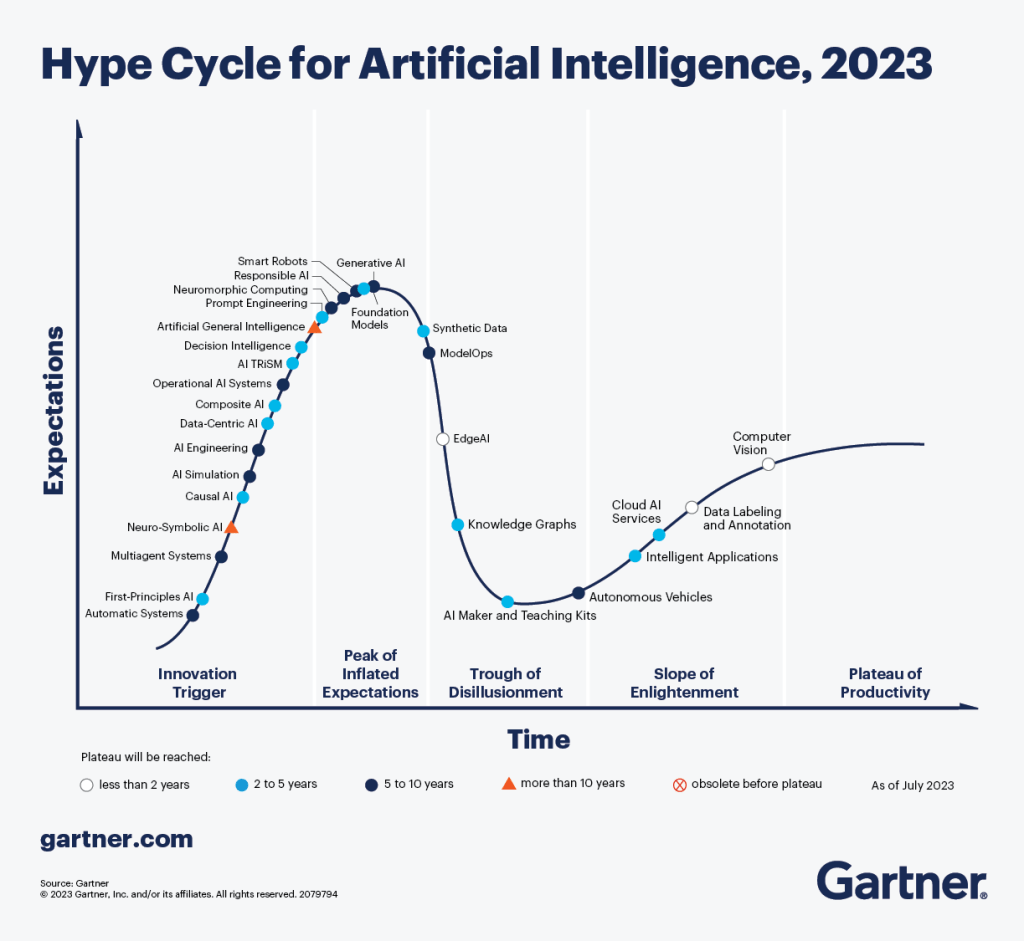
How does a Gartner Hype Cycle™ work?
A Gartner Hype Cycle provides an objective map that helps you understand the real risks and opportunities of innovation, so you can avoid adopting something too early, giving up too soon, adopting too late, or hanging on too long. Every Hype Cycle includes five phases:
The innovation trigger starts when an event, like a technological breakthrough or a product launch, gets people talking.
The peak of inflated expectations is when product usage increases, but there’s still more hype than proof that the innovation can deliver what you need.
The trough of disillusionment happens when the original excitement wears off and early adopters report performance issues and low ROI.
The slope of enlightenment occurs when early adopters see initial benefits and others start to understand how to adapt the innovation to their organizations.
The plateau of productivity marks the point at which more users see real-world benefits and the innovation goes mainstream.
———————*********——————***********———————
Though there are many more questions that arise and need to be explored and answered as we progress with the exploration of AI. However it’s not possible to cover each and every topic in a single blog post which makes it too long.
I believe this much content is sufficient for this “AI for Infra – Part 01” blog. We will cover other questions, challenges etc as we progress and cover them in my future parts of this series.
Before closing, I would like to touch up on one very important question on where to start on our learning, up-skilling or re-skilling process. I believe we should start with exploring Generative AI platforms like ChatGPT and Google Gemini (formerly Bard) and explore the options about how it can be leveraged to be utilised in a sensible manner in our day to day work.
Even someone without a technical background can easily incorporate it into their everyday routines. Take, for instance, my wife, who isn’t tech-savvy. She learned about ChatGPT from an external source and installed its Android app on her mobile phone. She frequently uses it to discover cooking recipes in various languages and to create short stories for our 7-year-old daughter. She mentioned that finding such content on ChatGPT is far more efficient than using Google search or browsing the internet.
I hope you find the blog post both enjoyable and informative. If you appreciate the content and believe it could benefit others, please consider liking and sharing it. Your valuable feedback for further enhancements would be greatly appreciated.
Thank You for reading☺️


Leave a Reply