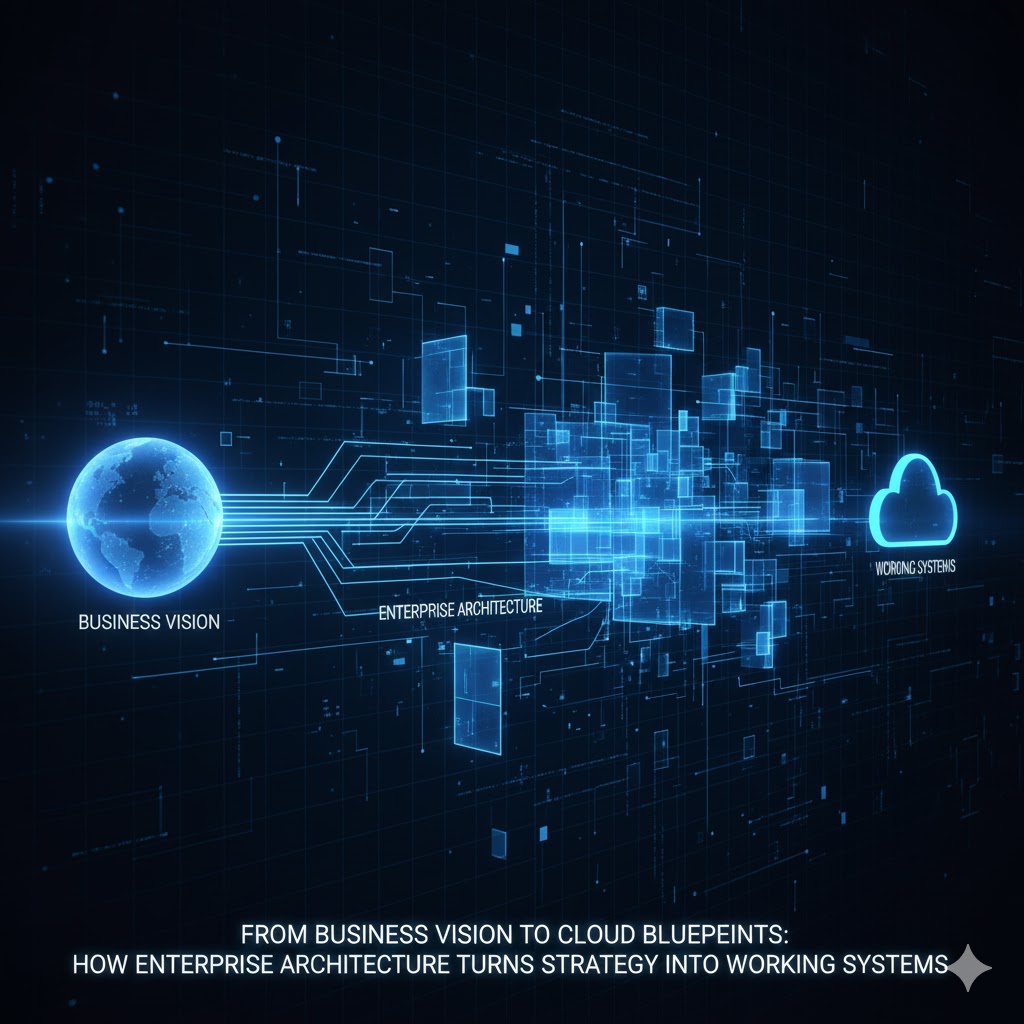
Every organization today wants results that sound deceptively simple: lower costs, faster delivery, trusted data, safer systems, and happier customers.
Yet the path from business goals to executable cloud solutions is rarely simple.
💡 Analogy: “The Expensive Car That Can’t Drive”
Organizations often have cloud platforms like having a top-end sports car — fast engine, premium components, cutting-edge sensors — yet it sits stuck in traffic because the road system wasn’t designed for it
Teams modernize Kubernetes platforms, implement CI/CD pipelines, build streaming systems, and invest in analytics, experiment with AI models — only to hear business leaders ask:
“Why are we spending so much, while still moving slow?”
The problem is almost never the cloud, the data stack, or the technology. The real issue is alignment.
➠ Cloud teams optimize for scalability.
➠ Data teams optimize for quality and pipelines.
➠ Security teams optimize for control.
➠ AI/ML teams optimize for model accuracy.
➠ Business leaders optimize for outcomes.
Without a shared language and direction, the organization moves — but rarely moves together..
Enterprise Architecture: Translating Business Intent and strategy into Technology Reality
💡 Analogy: “City Planning vs. Road Construction”
Cloud engineers are like construction experts building highways and flyovers. EA is the city planner who decides which roads lead to hospitals, airports, business parks, or residential areas. Without planning, even the best roads don’t take you where you need to go.
If cloud engineers and architects build the digital infrastructure, Enterprise Architecture (EA) defines what that infrastructure must enable and why
EA clarifies:
➠ What the business is trying to achieve
➠ Which capabilities matter (real-time scoring, secure sharing, AI, cost governance, etc.)
➠ Who owns data and decisions across domains
➠ Which rules architecture must enforce (compliance, privacy, budget, lineage)
EA defines the “what” and “why,” while cloud architecture and platform engineering delivers the “how.”
Rather than chasing tools, EA ensures platforms deliver capabilities such as:
➠ Real-time decisioning
➠ Secure data sharing
➠ Cost governance
➠ Predictive insights/analytics
➠ AI-driven recommendations & automation
➠ Compliance-first architecture
These capabilities then shape how platforms are designed — influencing identity and access controls, data contracts, FinOps guardrails, automation, lineage, and observability.
💡Analogy: “Building a Hospital, Not Just Rooms”
You don’t build a hospital by starting with walls and beds. You begin by defining capabilities — emergency care, surgery, diagnostics, pharmacy, neonatal care. Only then do you decide how many ICUs, oxygen lines, sterile rooms, and MRI machines are needed. The capability determines the infrastructure.
When business becomes the driver, the cloud becomes purposeful — not just modern.
How Strategy Shapes Cloud & Platform Decisions
Once capabilities are clear, infrastructure becomes intentional — instead of generic.
➠ Real-time decisions → streaming + low-latency IAM + autoscaling budgets
➠ Secure sharing → domain IAM roles + encrypted contracts + policy-as-code
➠ FinOps discipline → resource monitors + domain budgets + tag enforcement
➠ Predictive analytics → ML pipelines + feature store contracts + audit trails
➠ AI-driven scoring & recommendations → GPU/TPU pools + secure model hosting + model lineage + inference observability
➠ Compliance-first → zero-trust, encryption, audit, regional rules
These are not tool choices. They are cloud platform patterns defined by business strategy.
EA Is the Connection Between Strategy and Cloud
💡Analogy: “Different Languages, Same Goal”
Business teams speak like a customer explaining symptoms. Cloud teams speak like doctors diagnosing with medical terms. Without translation, both are right — yet both misunderstand each other.
Business leaders speak in:
➠ Customer acquisition
➠ Fraud losses
➠ Revenue uplift
➠ Safety incidents
➠ Operational efficiency
➠ Production yield
➠ Cost per transaction
➠ Compliance and sustainability
Cloud, Platform, Data and AI teams speak in:
➠ Microservices
➠ IAM and zero-trust
➠ Kubernetes clusters
➠ Data quality & pipelines
➠ SLOs & observability
➠ FinOps budgets & tagging
➠ Catalogs, lineage & contracts
➠ GPU pools & feature stores
Somewhere between these worlds, the “why” is lost and the “how” becomes disconnected.
EA prevents that misalignment.
What EA Ensures (In Human Language)
➠ We don’t build features without a business capability
➠ We don’t collect or share data without ownership and purpose
➠ We don’t automate unless we can measure value
➠ We don’t “move to cloud” without expected outcomes
Simply put:
EA prevents misalignment by defining what matters and why, so engineers build what the business truly needs.
Real-World Examples Across Industries
💡Analogy: “Credit Cards for Domains”
Just like family members with their own spending limits on separate credit cards, each business domain should have its own budget, rules, and spending visibility. Shared data without accountability drains value like a shared bank account without statements.
| Industry | Business Goal | Cloud/IT Need | EA Alignment |
| Banking | Detect fraud in seconds | Real-time analytics, secure access | Capability definition + governance |
| Retail | Personalized offers at checkout | Behavioral data, ML pipelines | Data ownership + privacy model |
| Oil & Gas | Predict equipment failure | IoT ingestion + edge processing | Asset domain strategy + safety rules |
| Manufacturing | Improve production yield | Sensor data, analytics, dashboards | Standard KPIs + data contracts |
| E-commerce | Reduce delivery delays | Logistics tracking + APIs | Domain boundaries + integration |
| Healthcare | Protect patient data | Zero-trust identity, audit trails | Compliance-first architecture |
These outcomes are not achieved by tools alone. They are achieved through aligned capabilities, ownership, and policies.
Cloud Architecture’s Real Job: Make Strategy Executable. Once capabilities and enterprise rules are defined, cloud engineering turns them into scalable platforms.
Accelerate Delivery
➠ CI/CD
➠ Platform engineering
➠ Self-service data access
➠ Reusable IaC modules
Enforce Security & Compliance
➠ Zero-trust identity
➠ Encryption everywhere
➠ Lineage and audit logs
➠ Policy-as-Code
💡Analogy: “Seatbelts Built Into Cars, Not Attached Later”
Compliance should be built into platforms the way seatbelts are built into cars — not bolted on afterward like an accessory. It should be impossible to drive unsafely by design.
Enable Cost Accountability
➠ FinOps guardrails
➠ Resource monitors
➠ Domain budgets
➠ Usage tagging
Support Trusted, Real-Time Decisions (Analytics + AI)
➠ Data quality enforcement
➠ Data contracts
➠ Catalogs + lineage
➠ APIs and governed sharing
➠ Model lineage & secure model hosting
➠ GPU/TPU resource governance
➠ AI measured by business value, not accuracy alone
➠ (Data Mesh only when needed)
💡Analogy: “A Brain Needs a Nervous System”
AI models are like a brain, but without a nervous system (real-time signals, governance, lineage, feedback), the brain has no way to sense, react, or learn from the environment. The architecture is the nervous system.
Scale Across Teams
➠ Event-driven systems
➠ Microservices
➠ Decentralized ownership
➠ Multi-region patterns
👉 Cloud architecture translates ambition into execution.
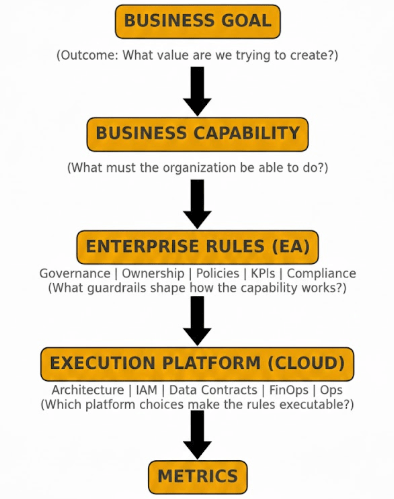
“The B2E2 Framework: Aligning Business and Cloud“
Business Goal → Business Capability → Enterprise Rules → Execution Platform
📌 Tagline:
“Don’t start with the cloud. Start with the capability.”
What it does:
This framework translates business intent into governed, scalable cloud design. It ensures we build platforms to deliver value, not just technology.
The Flow: From Vision to Execution
Example 1
➠ Goal: Reduce fraud
➠ Capability: Real-time risk scoring
➠ EA Standards: Data classification, access rules, event patterns
➠ Cloud Execution: Streaming platform, secure sharing, FinOps guardrails
Example 2
➠ Goal: Reduce factory downtime
➠ Capability: Predictive maintenance
➠ EA Standards: IoT identities, asset rules
➠ Cloud Execution: Edge ingestion, ML pipelines, audit controls
Industries change however alignment model doesn’t.
Where Data Mesh Fits (Only When Needed)
Data Mesh helps when:
➠ Many domains need shared, governed data
➠ Centralized data engineering cannot scale
➠ Teams can serve data & AI as products
AI models trained on domain data require ownership, quality rules, access control, lineage, and audited sharing — exactly what Mesh enforces.
EA decides whether Data Mesh makes sense. Cloud ensures it is secure, compliant, and cost-controlled. Data Mesh is a pattern, not a silver bullet.
💡Analogy: “Restaurants vs. One Big Kitchen”
A single centralized data team is like a giant kitchen cooking meals for thousands of restaurants — delays are guaranteed. Data Mesh empowers each restaurant to run its own kitchen, with shared hygiene rules, recipes, and inspection standards.
Mini Story 1: Real-Time Decisions in Banking & Retail
A leading bank and a major retail chain both needed real-time decisions.
➠ Fraud alerts arrived too late to block losses
➠ Personalized offers were triggered after checkout
Despite modern platforms, insights moved slower than the business.
💡Analogy: “Traffic Lights for Real-Time AI”
Fraud detection and personalized offers are like traffic lights — useless if they update 5 seconds late. Without real-time architecture, AI models behave like traffic lights that change after cars have already passed.
Mini Story 2: When Architecture Made AI Useful
A bank and a retailer both built AI models:
- Fraud scoring
- Personalized recommendations
Yet both failed to use them in real time.
Why?
AI couldn’t influence live transactions because architecture lacked streaming standards, domain ownership, lineage, and policy enforcement.
EA Didn’t Start with Tools — It Started with Rules
➠ Data owned by domains (Fraud, Customer Behavior)
➠ Policy-driven access (not manual approvals)
➠ KPIs tied to real-time business moments
▸ Fraud dollars saved
▸ checkout revenue uplift
Mandate shifted from “build faster pipelines” to “Make real-time decisioning a governed business capability.”
Cloud Made This Capability Executable
➠ Event streaming
➠ Domain boundaries in storage
➠ Policy-as-Code
➠ FinOps budgets per domain
➠ SLOs & observability
➠ GPU governance & secure inference
➠ Reusable IaC modules for traceable compliance
👉 AI didn’t fail technically. It failed architecturally.
Cloud didn’t solve the problem. Cloud turned business policy into a scalable engine.
| Outcome | Banking | Retail |
| Real-time decisions | Fraud decisions drop from minutes to seconds | Offers applied before payment, not after |
| Accountability | Risk team owns fraud signals end-to-end | Marketing owns customer event products |
| Compliance automated | PCI/audit trails embedded automatically | Privacy + consent rules built into the platform |
| AI Value | Models influence live transactions | Recommendations applied in real time |
| Cost control | Domain budgets limit runaway analytics | Campaign workloads monitored per region/domain |
Both became faster, safer, compliant, and cost-aware — by design.
Subtle Takeaway
➠ The value wasn’t Kubernetes.
➠ It wasn’t Data Mesh.
➠ It wasn’t the AI models.
👉 The value was aligning capabilities, ownership, and enterprise rules — then executing them through cloud platforms.
When that happens, the cloud stops being a toolbox. Cloud becomes a business engine.
Cloud Alignment Checklist (Practical & Viral)
📌 Use this before starting any cloud initiative
1) Business Goal
✔ Clear outcome defined
✔ Business KPI identified (fraud prevented, yield improved, cost per tx, etc.)
2) Capability
✔ What must the org be able to do? (real-time decisioning, secure sharing, etc.)
✔ Who benefits from it?
3) Enterprise Rules
✔ Who owns the data / decisions?
✔ What policies govern access?
✔ Compliance & audit accounted for?
4) Execution Platform
✔ IAM, FinOps, contracts, observability aligned with rules
✔ Platform modules reusable?
✔ Policy enforced as code?
5) Measurement
✔ Value tied back to business KPIs
✔ Cost tracked to domain / capability
✔ Feedback loop in place
🔑 If any box is empty, architecture isn’t aligned.
💡Analogy: “Pre-Flight Aviation Check”
Pilots don’t fly because the plane looks modern. They fly only if every checklist item is validated: fuel, controls, weather, communication, sensors. Cloud initiatives must be treated the same way: if any box is empty, don’t take off.
I believe this is sufficient discussion in a single blog post. Instead of stretching it further, lets end it here. I hope you will find this post informative and could be able to take away some good and valuable information which might help you in some way in your career.😊
Happy learning and knowledge sharing!👍



Leave a Reply